



Garage door panels may look simple from the outside, but the steel skin has to survive roll forming, maintain a consistent surface, bond reliably with insulation foam and resist outdoor exposure. For sectional-door manufacturers, choosing steel only by color and nominal thickness is not enough.
What this guide helps manufacturers specify
- Galvanized steel, PPGI or PPGL for panel skins
- Typical steel-skin thickness ranges and why profile design matters
- Steel grade, elongation and roll-forming compatibility
- PE, SMP, HDP and PVDF exterior coating choices
- Reverse-side coating for PU foam bonding
- Wood grain, orange-peel, smooth and embossed finishes
- Zinc or Al-Zn coating, color control and protective film
Commercial material pages
For direct material sourcing, see our pre-coated steel coil for garage and sectional door panels.
For decorative residential doors, review wood grain metal for garage doors.
This article stays focused on material selection and manufacturing decisions rather than repeating product-page specifications.

What Is a Typical Sectional Garage Door Panel Made Of?
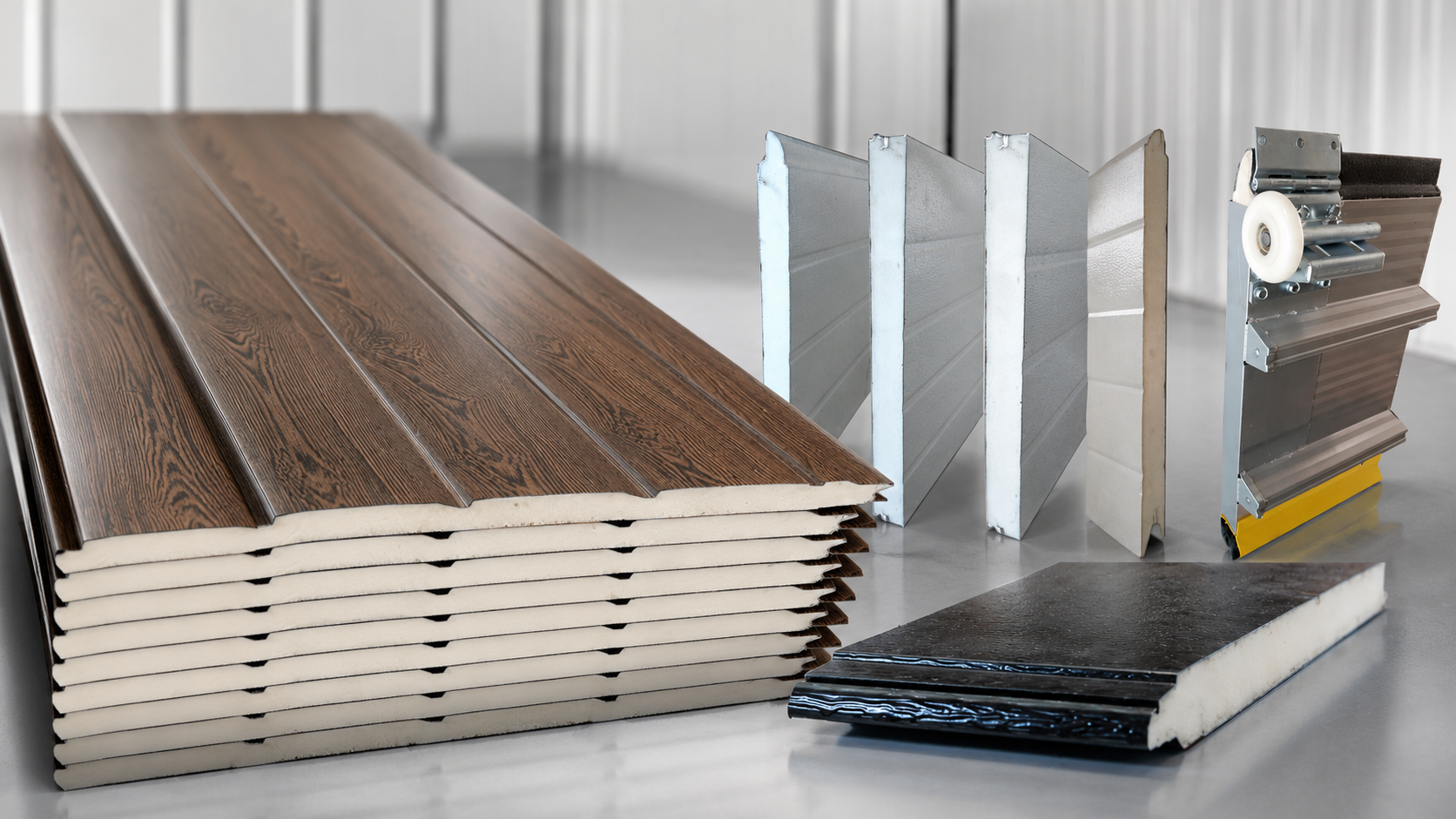
A common insulated sectional garage door uses two coated steel skins bonded to a rigid insulation core. The exact panel design varies by manufacturer, but the basic material logic is often:
Commercial sectional-door panel specifications commonly show galvanized or color-coated steel skins paired with polyurethane foam. Published examples also show steel skins in the roughly 0.3 to 0.5 mm range and insulated panel thicknesses around 40 to 50 mm. These numbers are useful as market references, not universal design standards.
Galvanized Steel, PPGI or PPGL: Which Is Used for Garage Door Panels?
Garage-door manufacturers may encounter several related steel terms. The key is to understand what each material actually includes rather than treating them as interchangeable names.
Galvanized steel
Steel coated with zinc for corrosion protection. It can be used as a substrate or for less appearance-critical components. Exposed decorative door skins normally need an additional finished surface.
PPGI
Prepainted galvanized steel combines the steel substrate, zinc coating, pretreatment, primer and factory-applied paint system. It is a practical route for color-coated sectional-door skins that go directly into roll forming.
PPGL
Prepainted aluminum-zinc coated steel uses an Al-Zn metallic coating beneath the paint system. It may be considered for corrosion-sensitive exterior applications, subject to the full exposure and edge-design requirements.
For the garage-door commercial material range, see pre-coated steel coil for garage door panels. For broader product parameters, use our PPGI specifications guide.
How Thick Should Garage Door Panel Steel Be?
Steel skin thickness is one of the first quotation items, but it should not be selected in isolation. Published garage-door panel examples show values such as 0.326 mm, 0.35 mm, 0.40 mm, 0.45 mm and 0.50 mm depending on the panel system.
Thinner skin may work when
- The panel profile provides adequate stiffness
- Ribs or embossing contribute to panel geometry
- The foam core and reinforcement are engineered for the load
- The roll-forming process is stable for the selected gauge
Thicker skin may be considered when
- The panel span or mechanical demand increases
- Industrial or commercial duty is more severe
- The profile requires additional resistance to local deformation
- The door manufacturer specifies it for the tested assembly
Steel Grade and Formability Matter as Much as Thickness
Garage door skins are normally roll formed, grooved, embossed, folded or stamped. The material therefore needs enough strength for the finished panel while remaining compatible with the actual forming geometry.
What can go wrong when material and profile do not match?
- Coating cracks around tight bends or embossed areas
- Edge cracking during profile formation
- Excessive springback
- Surface whitening or local paint damage
- Scratches caused by excessive contact pressure or tooling issues
- Dimensional instability after forming
What should be reviewed?
- Yield and tensile properties
- Elongation and bend behavior
- Panel profile and bend radius
- Roll-forming sequence
- Embossing depth
- Tooling clearance and condition
- Coating flexibility
- Trial-panel result

Which Paint Coating Is Suitable for Garage Door Panels?
The exterior steel skin is exposed to sunlight, rain, humidity, dust and temperature cycling. The paint system should therefore be selected around the actual service environment, appearance target and expected durability.
| Coating family | Typical selection logic | What to confirm |
|---|---|---|
| PE | General-purpose polyester for standard applications where extreme UV or aggressive exposure is not expected. | Color, gloss, forming flexibility, coating thickness and actual service environment. |
| SMP | Often considered when improved weathering is required compared with standard polyester. | Outdoor exposure, color family, forming demand and supplier-specific performance data. |
| HDP | High-durability polyester route for projects requiring stronger weatherability or color retention. | Coating specification, warranty basis, UV exposure and production compatibility. |
| PVDF | Premium exterior option for demanding color-retention and weathering requirements. | Whether the performance need justifies the cost and whether the forming process suits the system. |
For a dedicated comparison, review PE, SMP, HDP and PVDF coating systems.
Why the Back Coat Matters for PU-Foamed Garage Door Panels
This is one of the most important specifications in an insulated door panel and one of the easiest to overlook.
On a steel-PU-steel sandwich panel, the reverse side of each steel skin becomes part of the foam bonding interface. The back coating therefore needs to be compatible with the customer's actual foaming chemistry and production process.
Potential problems when the reverse side is not matched to the process
- Weak foam-to-steel adhesion
- Local separation or hollow areas
- Inconsistent bonding after cutting or cycling
- Production variation caused by contamination or storage conditions
Confirm with the steel supplier
- Reverse-side primer or back-coat structure
- Nominal back-coat thickness
- Surface cleanliness and storage expectations
- Any existing foam-bonding test data
Confirm in the door factory
- Actual PU or PIR chemistry
- Foaming temperature and line conditions
- Bond result on trial panels
- Cut-panel and aging behavior where required

Outer Skin and Inner Skin Do Not Always Need the Same Specification
Using the same material on both sides is simple, but it is not always the most efficient specification. The outer face and inner face perform different jobs.
Outer steel skin priorities
- Color and gloss consistency
- Weather resistance and UV stability
- Corrosion protection
- Decorative embossing or wood grain appearance
- Visible forming quality
Inner steel skin priorities
- Foam-bonding compatibility
- Corrosion protection
- Clean interior appearance
- Forming compatibility
- Cost control within the door design
The correct cost reduction is not simply choosing thinner or cheaper steel. It is placing the required performance on the side of the panel where that performance is actually needed.
Wood Grain, Orange Peel, Smooth or Embossed Steel?
Garage-door manufacturers use several surface finishes depending on the market and door design. Common options include smooth finishes, wood-grain textures, orange-peel textures, ribs, grooves and embossed cassette patterns.
Smooth or solid color
Simple appearance and easy visual control. Surface defects can be highly visible on large flat areas, so flatness and gloss consistency still matter.
Embossed texture
Texture can change appearance and the way the skin behaves during downstream forming. Material flexibility should be checked against embossing depth and profile geometry.
Wood grain
Used for residential doors where a timber appearance is wanted with a steel panel structure. Pattern repeat, grain direction, batch color and forming compatibility need tighter control.
For decorative garage-door material options, see wood grain metal for garage doors. For broader decorative patterns, see wood grain metal coil and sheet.
Embossing is not only an appearance decision
Deep grooves and decorative relief introduce local strain. As deformation increases, manufacturers should pay more attention to substrate elongation, coating flexibility, bend radius, tooling pressure and surface scratches.
For a detailed failure analysis, read our wood grain steel door skin defect guide.

Zinc or Al-Zn Coating Weight Should Not Be Ignored
Two prepainted steel coils can have the same color, nominal thickness and width while using different metallic coatings underneath the paint. That difference can affect corrosion protection and price.
This matters particularly after the door factory creates new exposed areas such as:
- Sheared panel ends
- Punched holes
- Lock and hardware openings
- Folded edges
- Deep scratches or coating damage
For galvanized material, our PPGI zinc coating guide explains common coating-weight designations and purchasing implications.
Color, Gloss and Batch Consistency Need Production Controls
A sectional door contains multiple horizontal panels installed next to one another. Small differences can therefore become more visible across the completed door than they appear on separate coil samples.
For appearance-critical projects, confirm more than a RAL number:
- Approved physical master sample
- Color tolerance
- Gloss range
- Surface texture
- Wood-grain pattern where applicable
- Grain or production direction
- Batch identification
- Rules for mixing production lots

Protective Film Is Part of the Production Specification
Protective film can reduce handling scratches on decorative steel, but the film itself must be compatible with downstream production.
Questions to confirm before bulk production
- Will the steel be roll formed with the film attached?
- Will the panel also be embossed or stamped?
- How much local stretching occurs?
- How long will the film remain on the panel?
- What storage temperature and sunlight exposure are expected?
- What removal conditions does the film supplier recommend?
For premium wood-grain or high-gloss finishes, protective film should be approved together with the actual forming process rather than treated only as shipping packaging.
Garage Door Panel Steel Specification Checklist
Before requesting quotations, a garage-door manufacturer should provide enough information for suppliers to quote comparable materials. The checklist below is a practical starting point.
| Specification item | What to confirm | Why it matters |
|---|---|---|
| Application | Residential, commercial or industrial sectional door | Sets the basic performance and appearance context. |
| Panel structure | Single skin or steel-foam-steel sandwich | Determines whether reverse-side foam bonding is critical. |
| Steel thickness | Nominal thickness and allowed tolerance | Affects forming, weight, rigidity and quote comparison. |
| Panel profile | Flush, ribbed, grooved, cassette, embossed or wood grain | Defines deformation and appearance requirements. |
| Steel grade | Grade and required mechanical properties | Must match forming geometry and strength requirements. |
| Metallic coating | GI or Al-Zn coated substrate and coating weight | Influences corrosion protection and cost. |
| Top coating | PE, SMP, HDP, PVDF or approved equivalent | Controls appearance and exterior durability. |
| Color and gloss | RAL or physical sample plus gloss range | Reduces batch and panel mismatch disputes. |
| Back coating | Reverse-side coating compatible with foam process | Critical for insulated-panel bonding. |
| Forming process | Roll forming, embossing, stamping and bend geometry | Determines formability requirements and trial method. |
| Protective film | Required or not, adhesion and removal conditions | Protects appearance without disrupting forming. |
| Coil width | Master or slit width required by the line | Affects yield, slitting and production setup. |
| Coil weight | Line handling and crane limit | Prevents receiving coils that the plant cannot safely process. |
| Service environment | Inland, coastal, humid, high UV or other special exposure | Guides metallic and paint-coating selection. |
Typical Material Selection Scenarios
The examples below are discussion starting points only. Final specifications must be validated by the door manufacturer against the real panel design, production line and required performance.
Standard residential sectional door
- Prepainted galvanized or Al-Zn coated steel
- Moderate steel-skin thickness selected for the profile
- General exterior coating system appropriate to the market
- Reverse coating validated for PU bonding
Premium wood-look residential door
- Controlled wood-grain pattern and direction
- Physical master-sample approval
- Gloss and batch-color control
- Forming and embossing compatibility
Industrial sectional door
- Profile-specific strength and skin-thickness review
- Reinforcement and span requirements
- Durable coating selected for exposure
- Forming stability on high-volume production lines
Coastal garage door
- Stronger attention to metallic coating and exterior paint system
- Cut-edge and punched-edge exposure review
- Salt, humidity and storage conditions considered
- Actual project requirements confirmed before final specification
Five Common Purchasing Mistakes
1. Comparing only price per ton
A lower quotation may use a different metallic coating, paint system, thickness tolerance, steel grade or reverse coating. Compare the complete material structure.
2. Approving only a flat color sample
A flat sample can look perfect and still crack, scratch or distort after roll forming and embossing. Approve a formed panel for new profiles or unfamiliar material systems.
3. Ignoring the back coat
For insulated sandwich panels, the reverse surface is part of the foam bonding system and should be specified accordingly.
4. Using one specification for every market
An inland residential door and a coastal exterior door do not automatically need the same corrosion and weathering specification.
5. Treating wood grain as only a color
Wood-look steel also requires control of pattern, repeat, direction, gloss, texture, batch consistency and forming behavior.
Final Recommendation
There is no single universal steel specification for every garage door panel. The correct material is a combination of steel grade, thickness, metallic coating, paint system, reverse coating, surface finish and forming compatibility.
For garage-door manufacturers, the most reliable specification is developed around the real panel profile and production process. Before bulk production, validate the material on the actual roll-forming, embossing and foaming process whenever practical.
This approach reduces the risk of coating cracks, bonding failures, color disputes and unnecessary material cost before those issues reach mass production.
- Overhead Door: Garage Door Materials — downstream market context for steel and decorative garage-door materials.
- Norton Door: Sandwich Panel Garage Doors — example of commercial insulated panel construction and published material ranges.
- Newton Garage Doors: Sectional Garage Door Panel Example — example of published steel-skin and panel specifications.
- National Coil Coating Association: Can Prepainted Metals Be Formed Successfully? — background on downstream forming of prepainted metal.
Published third-party panel dimensions and steel gauges are shown as market examples, not as universal engineering requirements.
Need Steel for a Garage or Sectional Door Panel?
Send the panel profile, steel thickness, coating requirement, color or wood-grain sample, coil width, forming method, foam system and destination market. Everest can help review the material structure and prepare samples or trial material before bulk production.
Garage Door Steel Solutions Wood Grain Garage Door Steel Contact Everest Steel [email protected]Garage Door Panel Steel FAQ
What steel is commonly used for garage door panels?
Insulated sectional garage doors commonly use galvanized or aluminum-zinc coated steel skins, often supplied as prepainted steel. The final choice depends on panel design, forming requirements, exterior exposure, appearance and foam-bonding requirements.
What thickness of steel is used for garage door skins?
Published commercial examples often fall roughly in the 0.3 to 0.5 mm range, but there is no universal thickness. The correct value depends on panel profile, span, reinforcement, foam core, forming process and the tested door design.
Is PPGI suitable for sectional garage doors?
Yes, PPGI is widely suitable for color-coated garage-door skins when the steel grade, zinc coating, paint system, back coat and forming behavior are matched to the manufacturer's panel design and service environment.
Why is the reverse-side coating important on insulated garage door panels?
The reverse side of the steel skin bonds to the PU or PIR insulation core. Its primer or back-coat structure therefore needs to be compatible with the actual foam system and production process.
Can the outer and inner steel skins use different specifications?
Yes. The outer skin usually needs stronger control of weather resistance, appearance, color, gloss and surface finish, while the inner skin may prioritize foam bonding, corrosion protection and cost. The final combination must still meet the door manufacturer's engineering requirements.
What information should a garage-door manufacturer send for a steel quotation?
Useful information includes panel application, single-skin or sandwich construction, steel thickness and tolerance, profile, grade, metallic coating, paint system, color or sample, gloss, reverse coating, forming method, protective-film requirement, coil width, coil weight and end-use environment.

